Dogecoin ETFs lose their bite as Bitcoin, Ethereum big dogs lead the pack

cointelegraphPublished on 2025-12-09Last updated on 2025-12-09

Abstract

US spot Dogecoin ETFs are experiencing a significant decline in trading activity, with total value traded (TVT) dropping to a record low of $142,000, far below the peak of over $3 million seen in late November. This cooling demand contrasts sharply with Dogecoin's strong performance in the broader crypto market, where it maintains over $1.1 billion in daily spot trading volume and a $22.6 billion market cap. The discrepancy suggests investors prefer accessing DOGE directly through exchanges rather than via ETFs. Meanwhile, Bitcoin and Ethereum ETFs continue to dominate the market, with TVTs of $3.1 billion and $1.3 billion respectively, underscoring their dominance in the regulated crypto ETF space. Other altcoin ETFs, including those for Solana and XRP, trail significantly behind in trading volume.

US spot Dogecoin exchange-traded funds (ETFs) are showing early signs of cooling demand, as total value traded (TVT) has fallen to its lowest level since launch.

SoSoValue data shows that on Monday, Dogecoin ETFs’ TVT fell to just $142,000, the lowest since launch. This marks a sharp retreat from late November, when the funds saw days where value traded topped $3.23 million.

Total value traded refers to the total dollar amount of ETF shares bought and sold over a given period. It serves as a gauge of market activity and practical liquidity, indicating the amount of money that has moved through the funds.
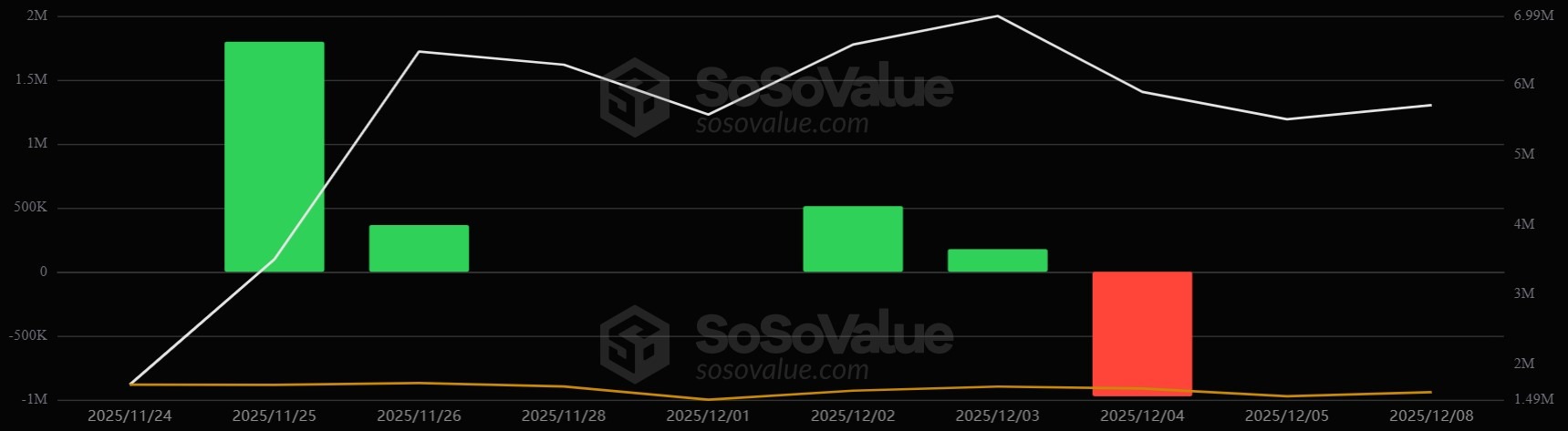
Daily spot ETF net inflows and total net assets. Source: SoSoValue

The contrast is stark when compared to Dogecoin (DOGE) activity in the broader crypto market. CoinGecko data shows that in the last 24 hours, DOGE recorded over $1.1 billion in spot trading volume and has a market capitalization of $22.6 billion.

This shows that the underlying asset remains highly liquid, but not through its ETF wrappers. This discrepancy suggests that traders are accessing DOGE directly through exchanges rather than traditional market vehicles.

Grayscale’s Dogecoin ETF made its debut in November but fell well short of initial volume expectations. ETF analyst Eric Balchunas predicted at the time that the ETFs would get at least $12 million in volume. However, the ETF only saw $1.4 million on its first day.

Related: BlackRock files with SEC for listing of staked Ether ETF

Bitcoin and Ether dominate ETF trading as alt-ETFs trail behind

On Dec. 8, ETF trading activity remained concentrated on Bitcoin (BTC) and Ether (ETH)-based products. According to SoSoValue, Bitcoin ETFs posted $3.1 billion in TVT, while Ether ETFs recorded $1.3 billion.

Solana (SOL) ETFs saw $22 million in value traded, while XRP products recorded $21 million in value traded. Further down the curve, the recently-launched Chainlink ETFs recorded a $3.1 million TVT on the same day, while Canary’s Litecoin (LTC) ETF had about $526,000.

The data suggests that ETF capital still overwhelmingly flows toward the two largest digital assets, continuing their lead as the core liquidity centers of regulated crypto exchange-traded products.

In terms of inflows, XRP (XRP) remains strong. On Monday, XRP ETFs’ inflow streak remains unbroken since its launch. Meanwhile, Solana ETFs, which first had their inflow streak broken in November, are on a three-day inflow streak after seeing $32 million in outflows on Dec. 3.

Magazine: Bitcoin whale Metaplanet ‘underwater’ but eyeing more BTC: Asia Express


Related Reads

JPMorgan's 2026 Global Investment Outlook: Economic 'K-Shaped Divergence' Continues; AI Adoption Soars

JPMorgan's 2026 Global Investment Outlook highlights a continued "K-shaped" economic divergence in the U.S., where high-income groups and technology sectors benefit significantly, while middle- and lower-income populations and interest-rate-sensitive industries face ongoing pressure. The U.S. economy is expected to remain resilient, supporting risk assets like equities and corporate credit, though cyclical momentum is limited. The Federal Reserve will continue normalizing interest rates cautiously amid potential volatility. Key investment themes include balancing portfolios across stocks, bonds, and alternative assets to capture structural opportunities and diversify returns. Three critical questions for investors are whether stocks are overvalued, if profits can remain strong, and whether AI-related stocks are in a bubble. Growth stocks, particularly in technology, remain attractive due to strong earnings, while consumer stocks lag due to tax and spending pressures. AI beneficiaries extend beyond innovators to enablers (industrials, utilities) and adopters (finance, healthcare). Fixed income investments should focus on high-quality assets, with longer-duration bonds offering potential upside if rates decline. Despite a recent increase in international equity allocations, U.S. equities remain overweighted. The "60/40" stock/bond model is evolving into "60/40+" by incorporating alternatives for lower correlation and reduced volatility. Structural improvements in international markets and a weaker dollar support non-U.S. equities. Investors are advised to emphasize selectivity, diversification, and active management in a complex macro environment.

cointelegraph_中文Hace 24 min(s)

JPMorgan's 2026 Global Investment Outlook: Economic 'K-Shaped Divergence' Continues; AI Adoption Soars

cointelegraph_中文Hace 24 min(s)

Trading

Spot
Futures
活动图片